Calibration powders for a pH meter: 4.01, 6.86 and 9.18 — which to choose and how to dissolve them
Why a pH meter needs buffer solutions, why powder is better than a ready-made liquid, how many calibration points you need, and how to dissolve a sachet correctly in 250 ml of distilled water.
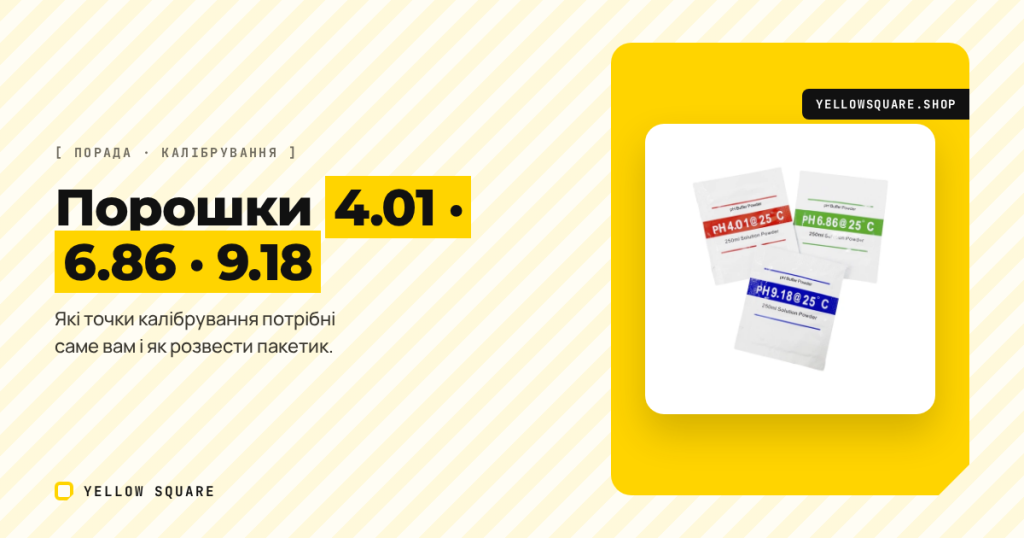
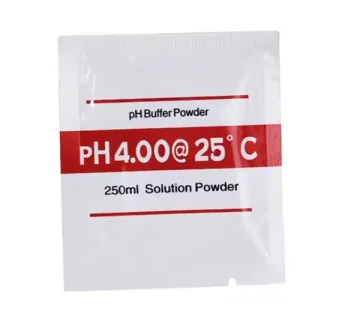
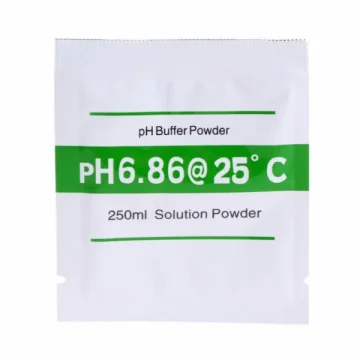
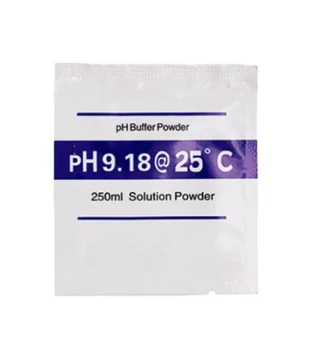
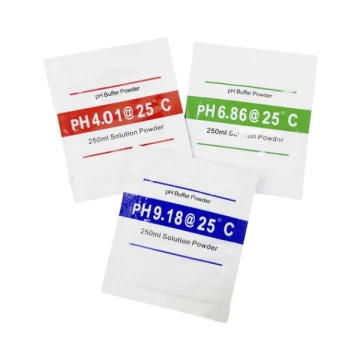
Calibration powder is a dry mix from which a reference buffer solution with a precisely known pH is prepared in a minute. One sachet is dissolved in 250 ml of distilled or deionized water at 25 °C. For most home tasks, two points are enough — 6.86 and 4.01 (or 6.86 and 9.18 for alkaline liquids); three points — 4.01, 6.86 and 9.18 — give accuracy across the whole scale. At Yellow Square, each powder costs 11 ₴, and a set of three costs 33 ₴.
A pH meter does not measure acidity directly: it measures the voltage on a glass electrode and converts it to pH using its internal “ruler”. For that ruler to be correct, the meter is shown reference standards — buffer solutions whose pH is known exactly. That is exactly what calibration powders are for.
What a buffer solution is and why powder
A buffer solution keeps its pH stable even if a little acid or alkali gets into it. That is why it is suitable as a reference standard. You can buy it in two forms — as a ready-made liquid in a bottle or as a powder in a sachet. Powder has several advantages:
- A fresh standard every time. The solution is prepared right before calibration, so it has no time to absorb carbon dioxide from the air or get contaminated.
- It does not go bad in storage. A sealed sachet keeps much longer than an opened bottle of liquid.
- It is cheaper. One calibration point — pH 4.01 powder, pH 6.86 or pH 9.18 — costs 11 ₴.
How many calibration points you need
The closer the buffers are to the values you actually measure, the more accurately the meter is calibrated. Here is how to choose:
| What you measure | Calibration points | Which powders |
|---|---|---|
| Drinking water, an aquarium with neutral water — “around 7” | 1 point | pH 6.86 |
| Hydroponics, soil extracts, juices, soft water — acidic range | 2 points | pH 6.86 + pH 4.01 |
| Pool, hard water, cleaning solutions — alkaline range | 2 points | pH 6.86 + pH 9.18 |
| Liquids with different acidity, laboratory, education | 3 points | pH 4.01 + 6.86 + 9.18 |
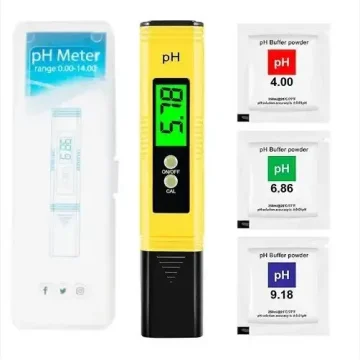
Even if the meter supports only two points, the third powder is useful: the 9.18 solution is a convenient way to check whether the pH meter is calibrated correctly. That is why, for the first setup, the most practical choice is the set of three powders for 33 ₴.
How to dissolve calibration powder correctly
- Take a clean, dry container and measure out 250 ml of distilled or deionized water. Tap, filtered or bottled water will not work — the dissolved salts will change the pH of the standard.
- Bring the water to about 25 °C — at this temperature the buffers have their nominal values of 4.01, 6.86 and 9.18.
- Pour in the entire contents of the sachet, leaving no powder on the sides.
- Stir until the solution is uniform, with no grains at the bottom.
- Label the container and use the solution for calibration right away.
In what order to calibrate
Always start with the neutral point pH 6.86, then the acidic 4.01 and, if needed, the alkaline 9.18. Between solutions, the electrode is rinsed with distilled water and blotted with a tissue. For a detailed step-by-step guide with the CAL button and a video, see the article “How to set up and calibrate a pH meter”.
4.00 or 4.01, 9.18 or 10.01 — how not to mix them up
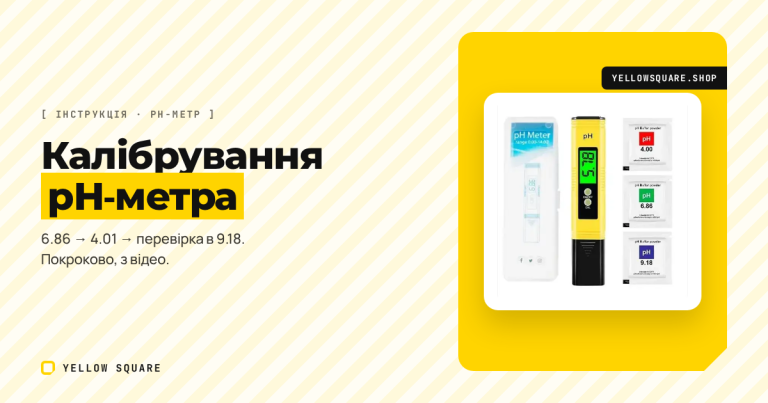
Different manufacturers use slightly different buffer sets: 4.00 / 6.86 / 9.18 or 4.01 / 7.00 / 10.01. Many pocket pH meters are calibrated with the 4.00 (4.01) / 6.86 / 9.18 set — these are the powders included with the Yellow Square pH meter. If your meter’s manual lists 7.00 and 10.01, check whether it can work with 6.86 and 9.18 before calibrating.
What if you need to calibrate an ORP meter
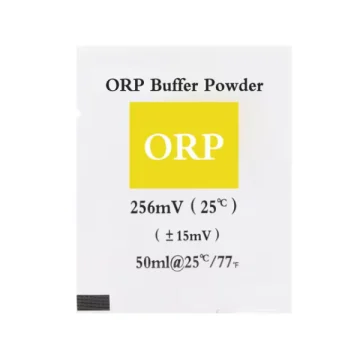
An ORP meter (oxidation-reduction potential) is calibrated not by pH but against a reference standard in millivolts. There is a separate 256 mV powder for it, which is dissolved in 50 ml of distilled water — pH buffers are not suitable for ORP.
Questions and answers
How much water is needed for one sachet of calibration powder?
250 ml of distilled or deionized water at a temperature of about 25 °C for Yellow Square pH 4.01, 6.86 and 9.18 powders.
Can a pH meter be calibrated at one point?
Yes, if you measure liquids with a pH of around 7: the 6.86 buffer is enough. For acidic or alkaline liquids, you need a second point — 4.01 or 9.18, respectively.
How long can a prepared buffer solution be stored?
A fresh solution gives the most accurate calibration. The leftover can be kept for a short time in a tightly sealed container, only for the next calibration with a clean electrode; a solution that other liquids have got into should be poured out.
How many sachets are needed per year?
If you calibrate once every 2–4 weeks, you will need 13–26 sachets of each point per year. That is why it makes sense to keep a stock: powder in a sealed sachet keeps much longer than a ready-made solution.
Where can I buy calibration powders for a pH meter in Ukraine?
At Yellow Square: pH 4.01, 6.86 and 9.18 powders for 11 ₴ each and a set of three for 33 ₴, from the warehouse in Kyiv, with delivery across Ukraine.