TDS meter: what it shows, how to use it, and which water readings are normal
A TDS meter shows in 10 seconds how much salt is dissolved in water, in ppm. We explain what the numbers mean, how to check a filter or reverse osmosis system, what a TDS meter won't show, and how to measure correctly with the TDS-3.
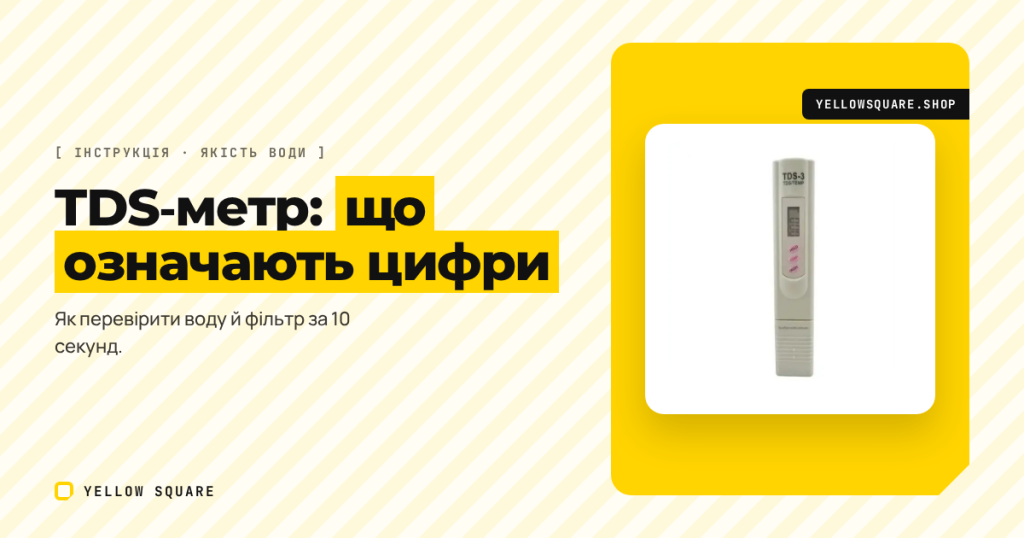
A TDS meter measures the total content of substances dissolved in water — salts and minerals — in ppm (parts per million, roughly mg/l). It determines this from the electrical conductivity of the water, so it shows “how much is dissolved” but not “what exactly”: a TDS meter cannot detect bacteria, nitrates separately, pesticides or pH. It is most useful for monitoring filters: after reverse osmosis, water usually has a few dozen ppm, and if the number starts to rise, it is time to replace the membrane or cartridges.
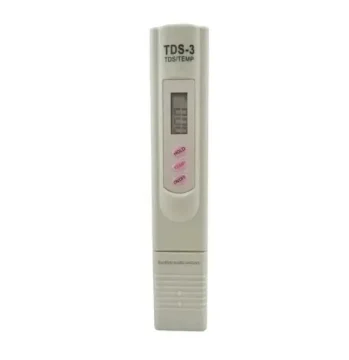
TDS stands for Total Dissolved Solids — “the total amount of dissolved solid substances”. These are calcium, magnesium, sodium, potassium, chlorides, sulfates, bicarbonates and other ions. A pocket TDS meter such as the TDS-3 meter measures the electrical conductivity of water between two electrodes and converts it to ppm. You see a single number on the screen, and that is enough to assess water from the tap, from a well, after a filter or in an aquarium.
How to use the TDS-3 TDS meter
- Remove the protective cap from the electrodes and turn the meter on with the ON/OFF button.
- Pour water into a clean glass — do not measure directly under a running stream, because air bubbles distort the reading.
- Lower the meter into the water up to the immersion mark (no deeper than the body with the buttons) and move it gently to remove bubbles from the electrodes.
- Wait until the number stops changing — usually a few seconds.
- Press HOLD to lock the value, and only then take the meter out and read the result.
- Rinse the electrodes with clean water, shake off the drops, and put the cap back on.
What TDS values are normal
There is no strict TDS “standard” for drinking water — it is an indicator of taste and mineralization, not of safety. As a guide: according to the World Health Organization, water with TDS up to about 600 mg/l usually tastes good, while above about 1000 mg/l it becomes increasingly less pleasant. An approximate scale for household use:
| TDS, ppm | What it usually means |
|---|---|
| 0–50 | water after reverse osmosis or distillation, very soft |
| 50–300 | soft or moderately mineralized water, typical of good drinking water |
| 300–600 | noticeable mineralization, more common in tap water and borehole water |
| 600–1000 | harder water: limescale in the kettle, an aftertaste |
| over 1000 | highly mineralized water — worth looking into the source and filtration |
High TDS does not by itself mean that the water is dangerous, and low TDS does not mean that it is microbiologically clean. For the full picture, you need a laboratory analysis.
How to check a filter or reverse osmosis system
- Measure the TDS of tap water before the filter and write down the number.
- Measure the water after the filter.
- Calculate how much the value has dropped. A reverse osmosis system usually removes most of the dissolved salts — in a properly working system, the output water has only a small fraction of the input TDS.
- Repeat the measurement every few weeks. If TDS after the filter gradually rises, the membrane or cartridges are wearing out.
Simple pitcher filters and activated carbon cartridges remove chlorine, odors and some impurities, but have almost no effect on TDS — don’t be alarmed if the number barely changes after them.
What a TDS meter won’t show — and what to add
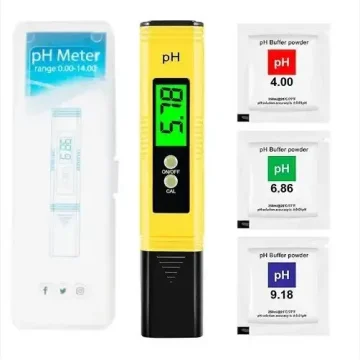
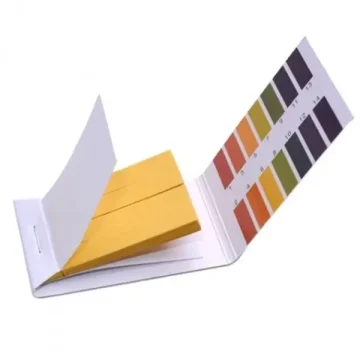
- Acidity (pH). This needs a separate device — a pH meter with 0.01 pH accuracy, or pH indicator strips for a rough estimate.
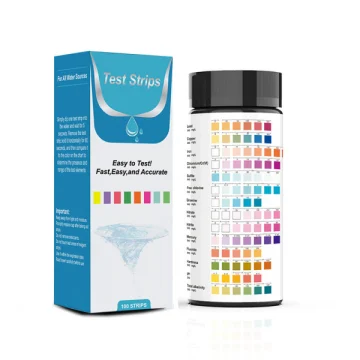
- Specific substances — chlorine, nitrates, nitrites, hardness, heavy metals. They are assessed by color with 14-in-1 test strips.
- Bacteria and viruses. Only a laboratory can detect them.
TDS for aquariums and hydroponics
In an aquarium, TDS helps you keep track of water changes and salt buildup, and in hydroponics — of the nutrient solution concentration: after adding fertilizer, TDS rises, and it is convenient to dose by it. Together with a pH meter, these are the two main instruments for growers and aquarium keepers — read about setting up a pH meter in the article “How to set up and calibrate a pH meter”.
Questions and answers
What does ppm mean on a TDS meter?
Parts per million. For water, 1 ppm is roughly equal to 1 mg of dissolved substances per 1 liter.
Does a TDS meter show whether water is safe to drink?
No. It shows only the total amount of dissolved salts. A TDS meter cannot detect bacteria, nitrates or pesticides separately — for that you need test strips or a laboratory analysis.
What should the TDS be after reverse osmosis?
Usually a few dozen ppm. The main thing is to compare it with the input water: if the difference shrinks over time, the membrane is losing efficiency.
What is the HOLD button for?
It locks the reading while you take the meter out of the water, so that the number does not change when the electrodes are in the air.
Where can I buy a TDS meter in Ukraine?
Yellow Square has the TDS-3 meter, as well as pH meters and water test strips, with delivery across Ukraine. Current availability is shown on the product page.